
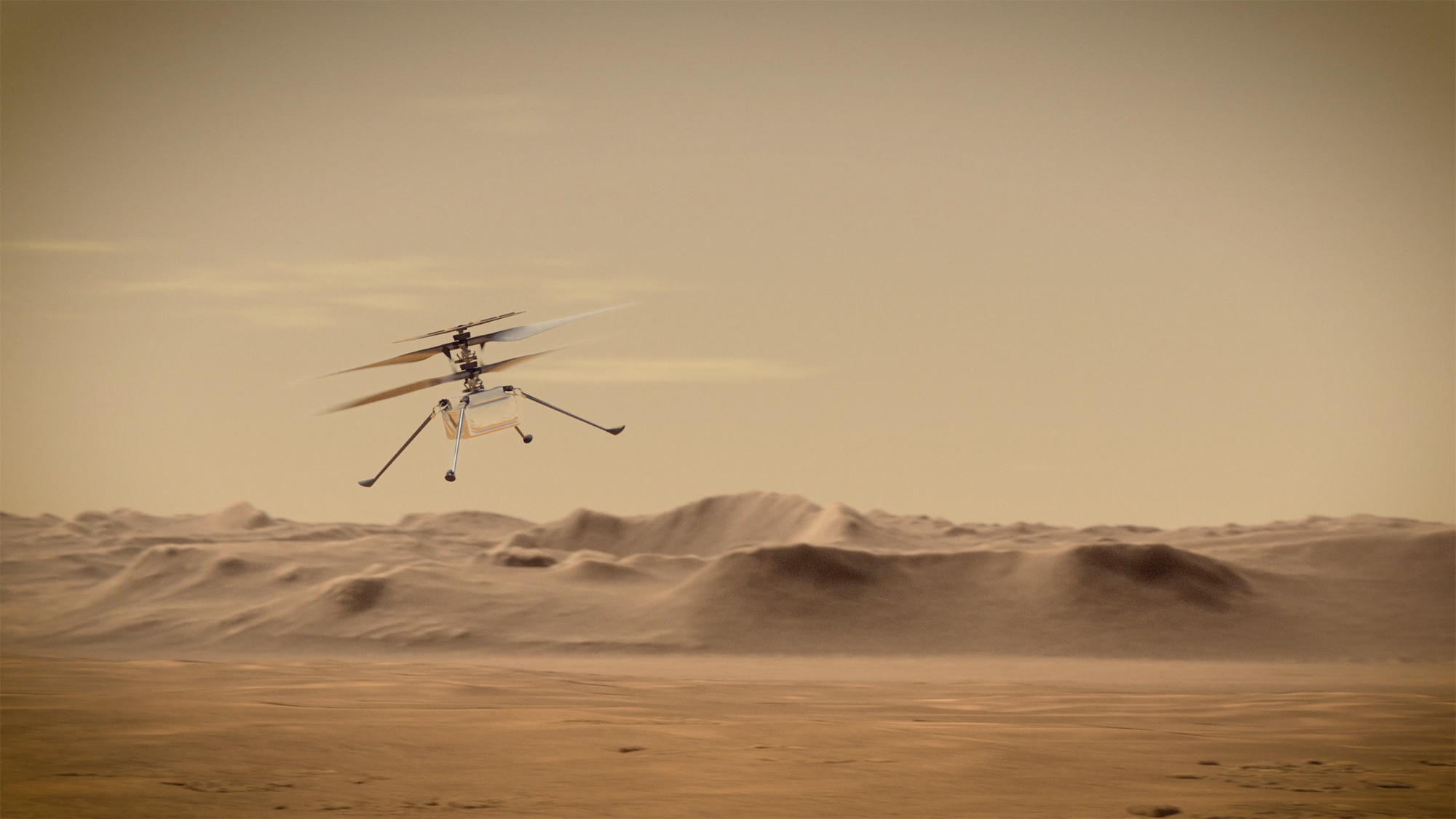
You would think that you could simply take an Earth helicopter to Mars, switch it on, and flight !! But, you soon realize that Mars has a density of 1% relative to earth. So, for every 10 particles on Earth, the helicopter is lifted by 1 on Mars.
The first answer to this question came with Ingenuity, which one April 19 2021 gave us the first proof of flight on another planet.
The physics of flight
As I've explained in previous articles, the rotating blades create a pressure difference, causing lift. If lift is greater than Mg or weight, the object flies.
The lift generated by a wing can be approximated using:
Where:
(L) is the lift generated.
(\rho) is the density of air.
(v) is the velocity of air relative to the wing.
(S) is the wing area.
(C_L) is the lift coefficient, which depends on the airfoil and its angle of attack.
The component exploited by the engineers at NASA, was the proportionality to the square of the velocity.
Engineering around an almost non-existent atmosphere
With atmospheric density roughly 100 times lower than Earth's, conventional helicopter designs simply wouldn't generate enough lift. Engineers had to compensate by increasing the velocity of air passing over the rotor blades.
Ingenuity's solution involved four specially designed carbon-fibre blades, arranged into two coaxial, counter-rotating rotors. These rotors had a diameter of approximately 1.2 metres and spun at an astonishing 2,400 RPM.
For perspective, this is roughly eight times the rotational speed of a conventional Earth helicopter.
The blades were also designed with carefully optimised airfoil profiles to generate as much lift as possible in the thin Martian atmosphere.
There was another advantage: Mars has only about 38% of Earth's gravitational acceleration. This meant Ingenuity needed considerably less lift to remain airborne than it would on Earth.
However, reduced gravity alone wasn't enough. The extremely low atmospheric density remained the primary engineering challenge.
A helicopter that flies itself
There was another problem that had nothing to do with aerodynamics: communication.
Mars is millions of kilometres away from Earth. Radio signals take several minutes to travel between the two planets, making real-time piloting impossible.
Instead, Ingenuity had to operate autonomously. It used onboard cameras, sensors and computers to monitor its position and stabilise itself during flight.
Its electronics also had to survive extremely cold Martian nights, relying on onboard heaters and batteries charged using solar energy.
In other words, this wasn't simply a helicopter with modified rotor blades. It was an entirely self-contained flying machine designed for an environment radically different from Earth's.
The Wright Brothers moment on another planet
On April 19, 2021, Ingenuity completed its first flight, ascending approximately three metres above the Martian surface before landing safely.
The original mission was designed for just five experimental flights over 30 days. Instead, Ingenuity completed 72 flights over nearly three years, travelling more than 17 kilometres in total.
Its final flight took place on January 18, 2024. Damage to its rotor blades during landing meant it could no longer fly.
Although its mission had ended, Ingenuity had demonstrated something previously considered extraordinarily difficult: powered, controlled flight was possible in the atmosphere of another planet.
It also provided engineers with valuable data that could influence the design of future aircraft for planetary exploration.
Perhaps the most interesting takeaway is that the principles of flight never changed. The same physics that allows a commercial airliner to cruise at 35,000 feet also allowed a tiny helicopter to fly on Mars.
What changed was the engineering required to make those principles work.