
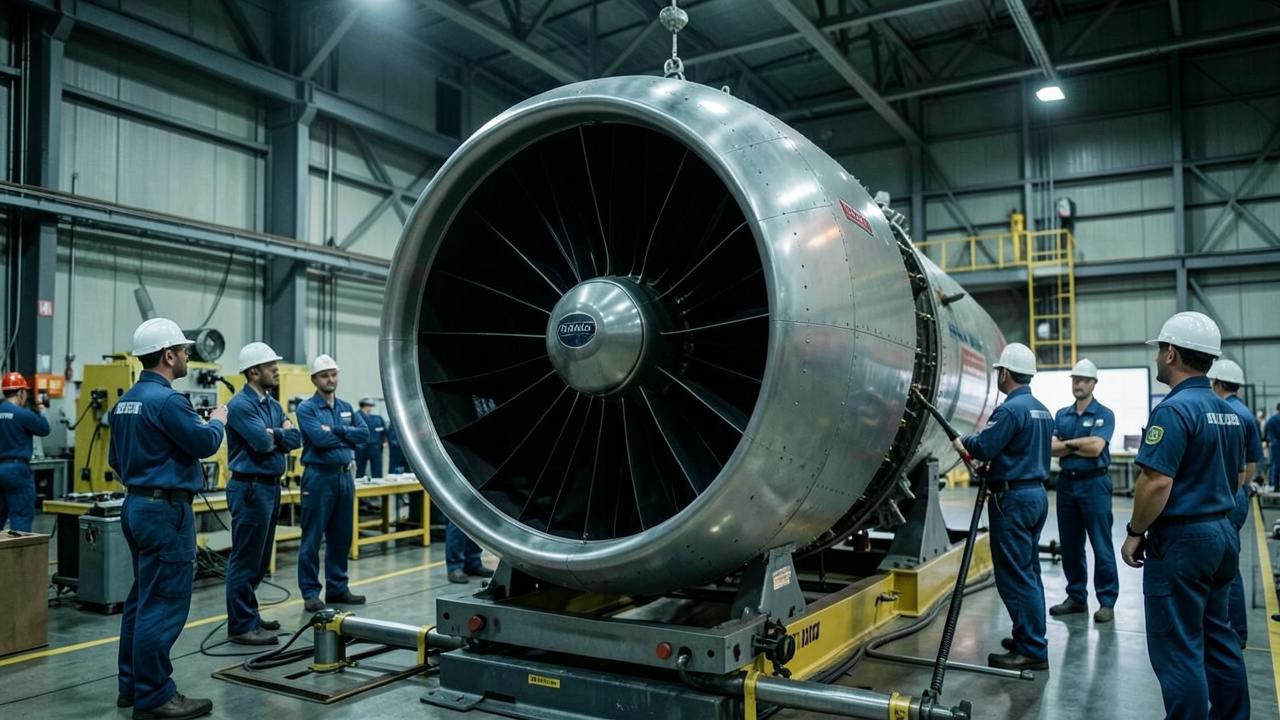
Turbofan efficiency improves with bypass ratio, and bypass ratio improves with fan diameter. Ducted engines have almost run out of room: a bigger fan needs a bigger nacelle, and the nacelle''s drag and weight eat the gain. The open fan removes the duct entirely.
How much is on the table
Demonstrator programmes target around 20 percent lower fuel burn and carbon dioxide than today''s best single-aisle engines, achieved through a very high effective bypass ratio, a compact high-pressure core running hotter with ceramic matrix composite parts, and hybrid electrical accessory power.
The three hard problems
First, noise: unshielded blade tips radiate directly, so blade count, spacing and clocking between rotor and stator rows are tuned obsessively. Second, containment: without a duct, a released blade must be handled by the airframe and structure rather than a casing. Third, integration: a very large diameter rotor changes wing position, landing-gear length and cabin noise.
Flight testing
Ground tests and flying testbed campaigns are running now, with an entry-into-service target aligned to the next narrowbody airframe rather than a retrofit. That means the engine and the aircraft arrive together in the mid-2030s.
Why it matters
Narrowbodies fly the majority of departures worldwide. A fifth off their fuel burn is the single largest efficiency lever available to the industry this side of 2040.